
Serengeti & Mara River 2028
Overview
Serengeti & Mara River 2028 – Victoria Falls, Lake Tanganyika, the northern Serengeti, the Ngorongoro Crater, Zanzibar and Lake Malawi
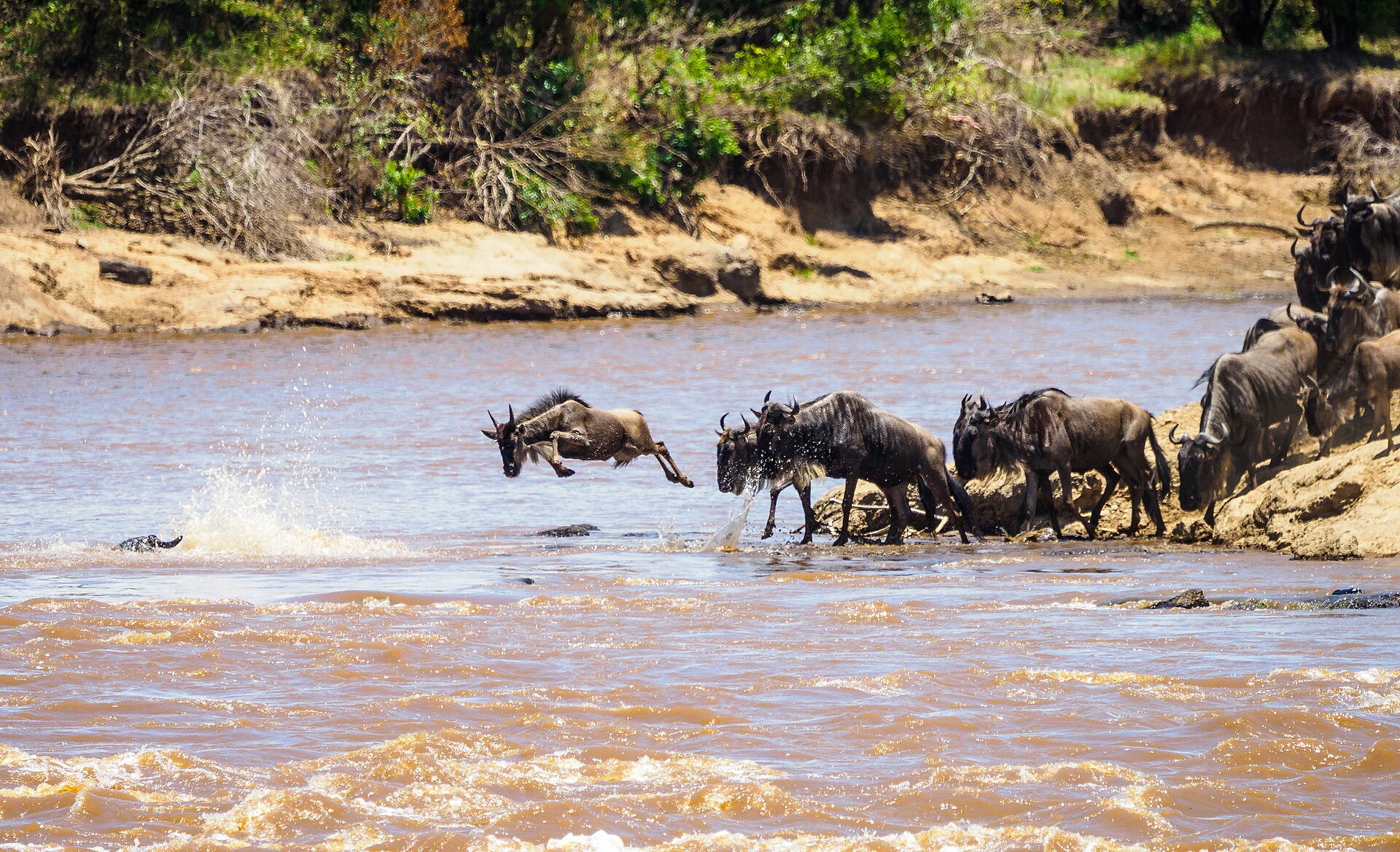
This is a one-off. I normally run my Serengeti tour around the Grumeti River, earlier in the year. In 2028 the Croatia tour takes that slot, so this time we go later and further north — all the way up to the Mara River on the Kenyan border, for the wildebeest crossings. It is a unique opportunity, and I won’t be repeating it every year.
The timing is deliberate. In early July the herds are usually in the far north of the Serengeti, and the first Mara River crossings normally happen in this window. We spend two nights at a special campsite in the northern section of the park — one group per site — so we can be at the crossing points from first light. Nobody can promise a crossing on a particular day, but this is the right place at the right time.
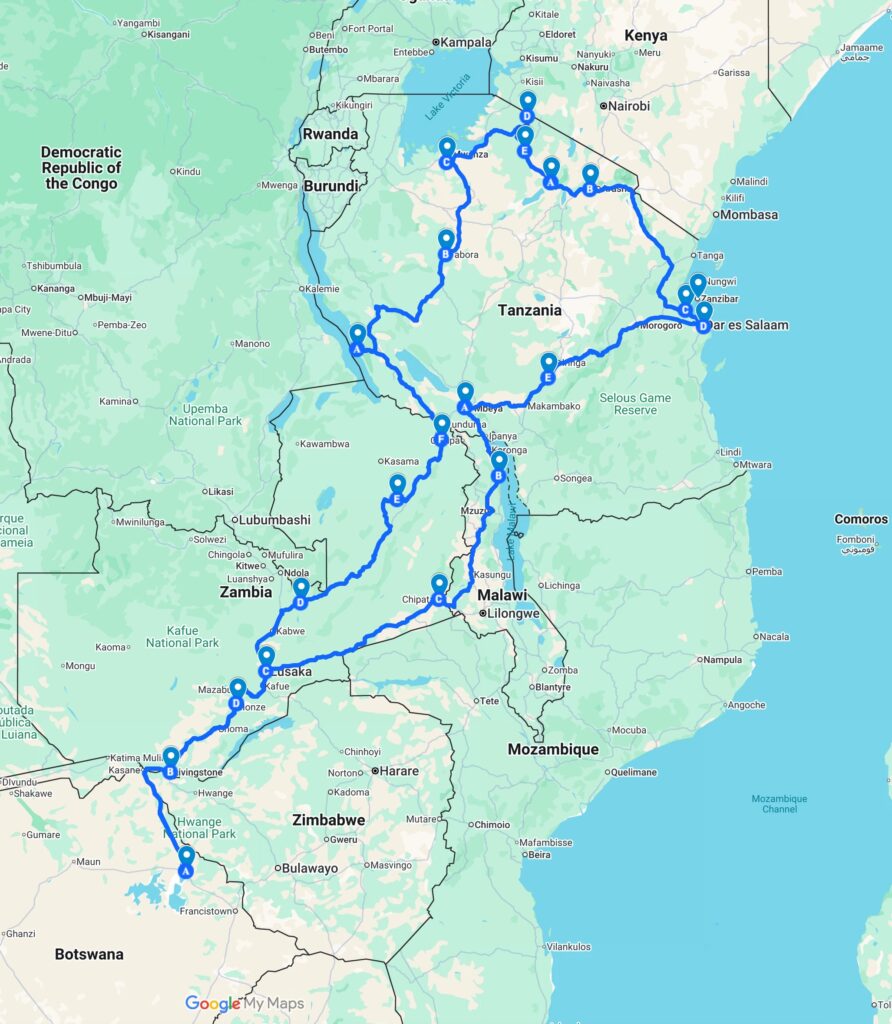
On the way north we take the quiet western route: Victoria Falls, the hot springs at Shiwa Ngandu, three nights on the shore of Lake Tanganyika and two on Lake Victoria at Mwanza. After the Serengeti and the Ngorongoro Crater we drive to the coast at Bagamoyo and Dar es Salaam, with an optional excursion to Stone Town on Zanzibar, and then come home through Tanzania’s Southern Highlands and three relaxed nights on Lake Malawi.
It is a big tour — 31 nights and around 8,150km from Nata back to Nata, mostly on tar, with gravel inside the parks. I personally guide it, and I am giving more than eighteen months’ notice so you have time to plan and save for it properly.
This tour is more than 12 months away, and campsites and national parks do not confirm their prices this far ahead.
The price shown is therefore subject to change. It will be adjusted closer to the time, and we will let you know of any change as soon as it is confirmed.
Tour at a Glance
- Departs 24 June 2028
- 31 nights
- 8,153km — Nata to Nata
- ±R72,060 per person sharing (USD 1,420 + R48,800)
- Max 14 guests
- 4x4 with low range
- Offroad van or trailer welcome
- Mostly tar, with gravel roads inside the Serengeti and Ngorongoro
- Optional Zanzibar excursion — own account, ±USD 350 pp
- Limited 220V power on tour
If this figure looks unfamiliar, rest assured it is still very much in line with our previous years’ tour prices. What has changed is its make-up: the stronger Rand and the current oil and diesel price problems both affect how the US dollar and Rand portions work out.
Estimated Customer Budget
| Bluerhino Tour Price – per Person (USD 1,420 + R48,800) | ±R72,060 |
| Bluerhino Tour Price – Total (2 Guests) | ±R144,120 |
| Fuel (Own Vehicle, Nata to Nata)* | ±R25,700 |
| Border Fees (Own Vehicle) | ±R8,200 |
| Total Customer Budget (2 Guests, 1 Vehicle) | ±R178,020 |
Estimate only. The tour price is the same for all guests and is made up of a US dollar portion (USD 1,420 per person) and a rand portion (R48,800 per person); the dollar portion is invoiced in rand at the exchange rate on the day of payment, and the rand total above is shown at R16.38 to the dollar. The tour price includes all camping fees, Serengeti and Ngorongoro park entry and vehicle fees, the Ngorongoro Crater service fee and guide fees. Park fees are quoted for vehicles under 2,000kg — heavier vehicles pay higher park vehicle fees, at the guest’s cost. Not included: the optional Zanzibar excursion (guests’ own account, approx. USD 350 per person — ferry, hotel, Stone Town and spice tours, meals), other activities, food, flights and personal miscellaneous costs. Assumes 2 guests sharing one self-drive vehicle. Border fees are approximate, for one vehicle at Kazungula, Tunduma, Songwe and Mchinji. *Fuel estimate based on the guide’s vehicle (Toyota Hilux 2.8 GD6) fuel consumption over the 8,153km meeting-to-farewell distance at current diesel pricing.
A Typical Day on Tour
Mornings start early — the sounds of Africa are best enjoyed with a cup of coffee and a rusk in hand. I’m usually up around 6am, and on a normal day we aim to be on the road about one and a half hours after sunrise. I’m firm on timekeeping — it’s only fair to the people who got up early to be ready.
Once we’re moving, we drive for around two hours before the first coffee stop — kettle’s on, with about 30 minutes to stretch your legs. Bring your cup and magic powders, I will supply the hot water.
A second stop follows around 2 hours later and it is normally a 45 minute lunch stop. Again I boil a kettle.
From here we can normally get to camp, but will stop if needed.
Once we’re in camp, I get a fire going, and supply the wood and charcoal — just bring your own braai grid. Evenings are for swapping stories around the fire, or private dinners with your spouse by candle light in the bush. I am easy with your choice.
The Itinerary
24 June – 24 July 2028 · 31 nights · ±8,150km, Nata to Nata
Section 1 – Nata to Lake Tanganyika
24 June – 2 July 2028 · ±2,340km
The safari begins at Nata Lodge, on the edge of the Makgadikgadi salt pans in Botswana, on 24 June. Next morning we cross into Zambia at Kazungula and overnight at Livingstone, close enough to see Victoria Falls the same afternoon. In late June the Zambezi is still high and the spray is spectacular.
From there we head north through Zambia, with overnight stops at Lusaka and Mkushi, to the natural hot springs near Shiwa Ngandu. This is where Stewart Gore-Browne built an English manor house in the African bush in the 1920s — the house and its story are well worth the visit, and a soak in the hot springs is the perfect end to a long driving day. A last night near the border at Kalungu, and we cross into Tanzania at Tunduma.
Our first Tanzanian stop is the shore of Lake Tanganyika — the longest freshwater lake in the world and the second deepest. We stay three nights: time to rest, swim in clear water, and watch the fishermen’s lamps out on the lake at night.
Section 2 – Western Tanzania, Lake Victoria, the Serengeti and Ngorongoro
3 – 10 July 2028 · ±1,810km
We leave the lake through western Tanzania, a part of the country few tourists ever see, to Tabora — an old caravan town on the 19th-century trade route to the coast. From there we drive to Mwanza on Lake Victoria for two nights. The granite boulders piled along the shoreline, Bismarck Rock among them, are what this lake city is known for.
From Mwanza we enter the Serengeti from the west and drive up to the northern section of the park, on the Kenyan border. Two nights at a special campsite here, one group per site, give us a full day for the Mara River crossing points and the plains to the north and east, wherever the herds happen to be.
Then we turn south through the heart of the park, past Lobo, to Seronera for two nights. The kopjes and the Seronera River valley are famous for lion, leopard and cheetah, and the game drives here are some of the best in Africa. On 10 July we leave the Serengeti at Naabi Hill and climb to the rim of the Ngorongoro Crater for a night on the edge.
Section 3 – The Ngorongoro Crater, the coast and Zanzibar
11 – 16 July 2028 · ±860km
Early the next morning we drive down into the crater: 260 square kilometres of grassland inside 600-metre walls, with black rhino, lion, hyena, flamingo and huge herds of buffalo and zebra. We climb out in the afternoon and overnight near Arusha.
Then a long day on tar past the slopes of Kilimanjaro to the coast at Bagamoyo, the old dhow port where the caravans from the interior ended. Next day we move to a beach campsite at Dar es Salaam for the rest of our coastal stay.
From Dar es Salaam there is an optional excursion to Zanzibar on 14 – 15 July: the ferry across, a night in Stone Town, a guided walk through the old town and the former slave market, and a spice tour. The vehicles stay safely parked in Dar es Salaam. The excursion is for the guests’ own account (approx. USD 350 per person) and is not included in the tour price. Two more nights in Dar es Salaam to rest, swim and restock.
Section 4 – The Southern Highlands, Lake Malawi and home
17 – 24 July 2028 · ±3,145km
We turn inland on the TanZam highway and climb into the Southern Highlands, with an overnight stop on the way to Mbeya, where we stay at a coffee estate.
From Mbeya we cross into Malawi at Songwe and follow the lakeshore south to Chitimba, at the foot of the Nyika escarpment, for three nights on Lake Malawi — the last real rest of the tour.
The road home takes us back into Zambia, with an overnight stop at Chipata, and on 24 July we arrive back at Nata Lodge for our farewell night. The group breaks up after breakfast on 25 July.
The Mara River – timing the migration
The wildebeest follow the rain, not the calendar. In recent years the herds were in the northern Serengeti, and the first Mara and Sand River crossings fell between about late June and mid-July — which is why this tour is in the north from 6 to 9 July. A crossing can happen within minutes, or not for a day or two — we will see how luck plays into our hands on the day. If the river is quiet, we drive around and find the large herds instead. The roads in the northern Serengeti are gravel and black-cotton soil, fine in the dry season. I drive a standard Toyota Hilux with no snorkel, avoid water crossings where I can, and never cross water deeper than my own vehicle can handle.
Photographs: mara river crossing – Danijel Mihajlovic (CC BY-SA 4.0); mara river crossing herd – Charles J. Sharp (CC BY-SA 4.0); serengeti migration – David Dennis from Pozuelo de Alarcón, Madrid, Spain (CC BY-SA 2.0); serengeti lion – Giles Laurent (CC BY-SA 4.0); serengeti kopje lioness – Richard Mortel from Riyadh, Saudi Arabia (CC BY 2.0); serengeti elephants – Ikiwaner (GFDL 1.2); ngorongoro black rhino – Ikiwaner (GFDL 1.2); stone town old fort – Diego Delso (CC BY-SA 4.0); stone town harbour – Diego Delso (CC BY-SA 4.0); victoria falls – Diego Delso (CC BY-SA 4.0); lake tanganyika fisherman – Worldtraveller (CC BY-SA 3.0); bismarck rock mwanza – Kitwee Kisai (CC BY-SA 4.0); lake malawi beach – Stefan Kraft Stefan7 (CC BY-SA 3.0); shiwa ngandu manor – Marcus Rozbitsky (CC BY 2.0); all via Wikimedia Commons. Other photographs © Bluerhino Safaris.
Previous Tours

Join the Bluerhino Newsletter
Get new tour dates, availability and safari stories straight to your inbox — no spam, just Africa.