

Morocco in a Motorhome 2027
Overview
Why Morocco? Roman ruins, Berber kasbahs, Atlantic surf and the Sahara — in a country you can actually drive in comfort.
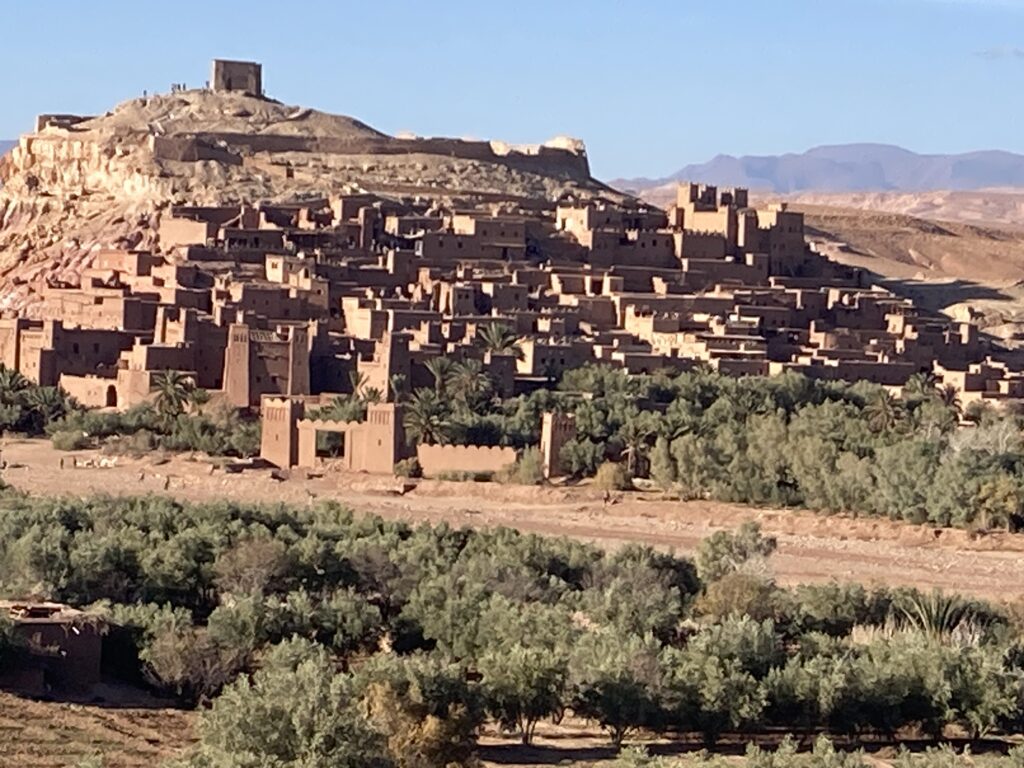
Morocco does nothing by halves. In three weeks you cross the High Atlas on a tarred mountain pass, sleep at the edge of the Erg Chebbi dunes, get properly lost in a medieval medina in Fès whose street plan has not changed in a thousand years, and finish eating seafood off the Atlantic. Roman, Berber, Arab and French history sit on top of one another here, and you taste it in the food, see it in the architecture and hear it in the language.
This will be the third running of this tour and my fourth time on the route. What makes it work is the vehicle. Motorhomes — camping cars, as they call them there — are everywhere in Morocco, because Europeans have been driving down for decades. The country is properly geared for them: good campsites, easy access, safe overnight parking, power at almost every stop. We rent luxury motorhomes with a built-in toilet, hot shower, central heating and air conditioning, so you travel light and sleep comfortably every single night.
The style is the same as all my tours — we travel as a group, but each party has its own vehicle and its own space. I run a planned route with GPS waypoints, and you are free to break away, linger somewhere, or catch us up later. There are six places on this route where we stay more than one night, so you get full days on foot in a medina or on the coast rather than always packing up.
And because Morocco is only two to three hours from most of Europe, a lot of my guests tack a European visit onto one end of the trip. Bucket lists are not kept for the sake of having lists — let’s go.
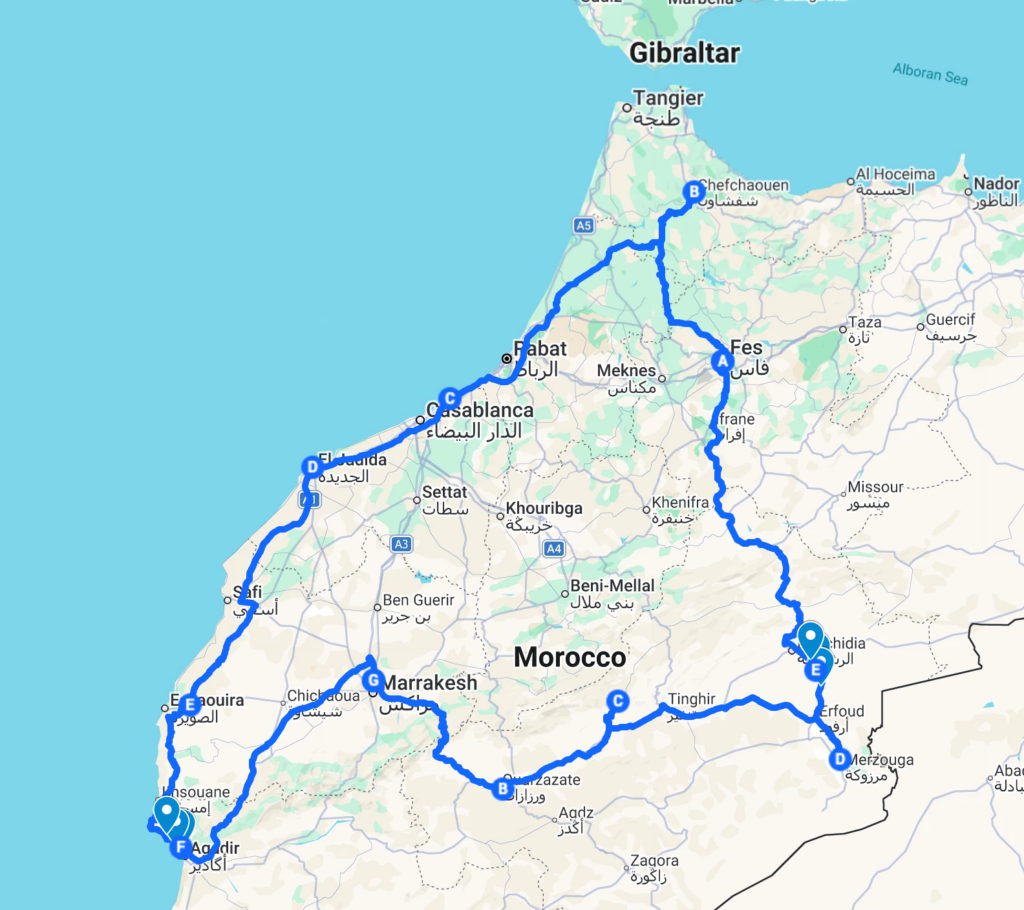
Tour at a Glance
- Departs 18 April 2027
- 19 nights
- Meeting and farewell point — Marrakech
- 2,702 km — Marrakech to Marrakech
- Morocco only — no border crossings
- ±R60,250 per person sharing, accommodation and motorhome included
- Max 12 guests in 6 motorhomes
- Luxury motorhome — toilet, hot shower, heating and air-con
- Good tar roads throughout
- 220V power at almost every campsite
Estimated Customer Budget
| Bluerhino Tour Price – per Person (excl. motorhome) | R34,000 + €375 |
| Motorhome hire (1 motorhome, shared by 2 guests) | €2,070 |
| Bluerhino Tour Price – Total (2 Guests, 1 Motorhome) | ±R120,500 |
| Fuel (full 2,702 km route, one motorhome)* | ±R10,200 |
| Border Fees | R0 |
| Flights – Economy return (2 Guests @ R18,000) | R36,000 |
| Visa – Morocco (2 Guests @ ±R1,000) | ±R2,000 |
| Total Customer Budget (2 Guests, 1 Motorhome) | ±R168,700 |
Estimate only. The euro amounts (€375 per person and €2,070 motorhome hire for the whole tour) are shown in rand at €1 = R18.62 (1 October 2026) and are invoiced in rand at the exchange rate on the day of payment. A Schengen visa is not needed for this tour. The tour price includes all riad and campsite fees for the 19 nights. Not included: food, activities, flights, visas and personal spending. The Merzouga camel excursion is arranged on the spot and paid direct — from 500 dirham per person. There are no border crossings on this tour, so no border fees.
Assumes two guests sharing one motorhome. *Fuel estimated at 7 km per litre over the full 2,702 km route (±386 litres) at around 15 dirham (±R26) per litre for diesel, September 2026 prices.
A Typical Day on Tour
Mornings are relaxed but not lazy. Your kitchen and bathroom are a metre from your bed, so breakfast happens in your own time — I am usually up around 6am, and on a driving day we aim to roll out about an hour and a half after sunrise. I am firm on timekeeping; it is only fair to the people who were ready.
Moroccan roads are good and the driving days are short by African standards — most legs are two to four hours. We stop every couple of hours, and because everyone is carrying their own kitchen, coffee and lunch stops are easy: pull in somewhere with a view, put the kettle on and take half an hour. Where there is a decent roadside café or a town worth walking through, we use that instead.
We reach camp in the afternoon with time to settle in, plug in and use the pool or the showers. Almost every campsite on this route has 220V power, so the fridge, the heating and your devices are all looked after.
Evenings are yours. Some nights the group eats together at the campsite restaurant or walks into town for a tagine; other nights people cook in their own vans and sit outside with a glass of wine. There are six places on this route where we stay more than one night — Marrakech, Merzouga, Fès, Chefchaouen, Mohammedia and Essaouira.
The second video below shows the type of motorhome we use.
The Itinerary
Section 1 – Marrakech, the High Atlas and the Dadès Gorge
18 – 22 April 2027 · 5 nights · ±360 km
We meet in Marrakech and spend the first two nights in a traditional riad inside the medina. A riad is a traditional Moroccan house built around a central courtyard or garden — plain walls on the street side, and a quiet, shaded oasis inside. Ours is within walking distance of the souks and the restaurants around the Jemaa el-Fnaa. Two nights there gets everyone over the flight and gives you time to get properly lost in the markets before we start driving.
On the third day we collect the motorhomes on the northern side of the city, get everyone comfortable with their van, and overnight on a campsite in Marrakech. Then we head south over the High Atlas Mountains — all switchbacks and Berber villages clinging to the slopes, with a completely different world on the far side. Ouarzazate, on the edge of the desert, is our first overnight outside the city.
The next day is a short one east to Boumalne Dadès, then up into the Dadès Gorge itself, where the road climbs through red rock and palmeries. It is one of the quietest nights of the tour and one of the best.
Section 2 – Todgha, the Erg Chebbi dunes and the Ziz Valley
23 – 25 April 2027 · 3 nights · ±360 km
Back down the gorge and on to the Todgha Gorge — a limestone slot three hundred metres deep that you can drive right into — and the Barrage Toudgha at the head of it. From there we head down to Merzouga, hard against the Erg Chebbi dunes. We arrive in the afternoon and sleep in the vans on the edge of the sand.
The following day is deliberately free — a shopping and pottering day. Late that afternoon, around 5pm, anyone who wants to rides camels out into the dunes for the overnight desert camp, coming back into Merzouga around 9am the next morning for a shower before we leave. The camel excursion is arranged there and paid direct, and the vans keep their pitch either way, so if you would rather sleep in your own bed you lose nothing.
On the 25th we run north-west up the Ziz Valley, past the Source Bleue de Meski and along one of the great palm-grove canyons in Morocco, to a small campsite in the palms below the Ziz Canyon lookout. This is a new stop for 2027 — it breaks what used to be one very long day between the dunes and Fès, and it is a lovely place to sit still for a night.
Section 3 – Over the Middle Atlas to Fès and Chefchaouen
26 – 29 April 2027 · 4 nights · ±630 km
An early start north, crossing the Middle Atlas through cedar forest and the improbably alpine town of Ifrane before dropping into Fès. It is the longest single drive of the tour and the scenery changes completely — desert to snow line to farmland in one day.
Two nights at Fès. The first day is for supplies, shopping and getting the laundry done; the second is the Medina. Fès el-Bali is the largest car-free urban area in the world — the medieval Chouara tanneries, where leather is still dyed by hand in stone vats; the Al-Qarawiyyin mosque and university, founded in 859 and regarded as the oldest continuously operating university in the world; and a street plan that has not changed since the ninth century. It is overwhelming in the best possible way.
From Fès we run north, dropping in at Volubilis — the best-preserved Roman city in Morocco, a thriving Roman provincial town from the 1st to the 3rd century AD, with the mosaics still lying where they were laid — then up into Chefchaouen. Two nights in the blue city. Photographs of Chefchaouen do it no justice at all; you have to walk it.
Section 4 – The Atlantic: Mohammedia, Casablanca and Essaouira
30 April – 4 May 2027 · 5 nights · ±830 km
Down out of the Rif to Mohammedia, on the beach just north of Casablanca. From there we take a day trip into Casablanca for the Hassan II Mosque — one of the largest mosques in the world, built right on the edge of the Atlantic. Its minaret rises 210 metres: just short of Joburg’s Carlton Centre (223 m), and about 60 metres lower than the Hillbrow Tower (269 m), the tallest structure in South Africa. Inside is mosaic work that took six thousand artisans five years to finish. You do not understand it from a photograph. You have to stand next to it.
Then the long coastal run south, stopping at El Jadida to walk the Portuguese cistern and fortress, and on to the argan and olive country just inland of Essaouira. Three nights here for 2027, up from two — because nobody has ever wanted to leave on time.
The day trip is into Essaouira: a walled Portuguese port, blue fishing boats, ramparts you can walk, sardines grilled straight off the harbour, and the best light on the whole tour.
Section 5 – Agadir and back over the Atlas to Marrakech
5 – 6 May 2027 · 2 nights · ±520 km
South, hugging the coastline, with a detour down to Imsouane — a fishing village with one of the longest right-hand point breaks in Africa — before rejoining the road to Agadir. We stay on the coast just north of the city.
The last leg turns inland, back across the plain to Marrakech. We refuel the vans, hand them back the next morning, and that is the tour. Most guests stay on a night or two in Marrakech, or fly straight up into Europe — it is only two or three hours away.
What this tour asks of you
This is not a 4×4 tour. We use Moroccan motorhomes on good Moroccan roads, the mountain passes are tarred, and the motorhome does the heavy lifting on comfort — you never pitch a tent and you never go without a hot shower. What it does ask is a willingness to be somewhere genuinely foreign: five calls to prayer a day, a language you do not speak, a currency you do not know, and markets where haggling is expected and thoroughly enjoyed. Come for that, and Morocco will spoil you.

Join the Bluerhino Newsletter
Get new tour dates, availability and safari stories straight to your inbox — no spam, just Africa.